
AI in LED Display Systems: Image Processing, Interaction, Content and Maintenance
Artificial intelligence is increasingly being added to the systems around professional LED displays, including video processors, media servers, content platforms, cameras, sensors and operation-and-maintenance software.
AI can assist with tasks such as image enhancement, content generation, computer-vision interaction and equipment monitoring. However, it does not replace the fundamentals of LED display engineering.
Pixel pitch, brightness, refresh rate, grayscale, calibration, LED quality and the control system still define the physical performance limits of the display.
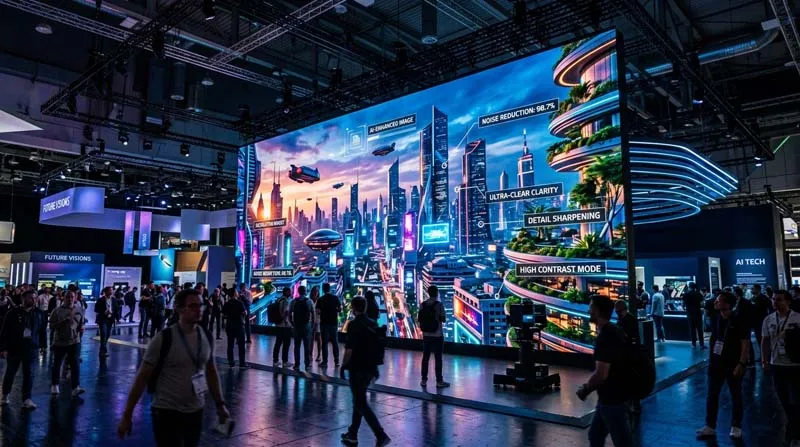
What Does AI Actually Do in an LED Display System?
In most professional installations, AI sits upstream of the LED modules. Cameras, sensors, media servers or software collect data; an AI model analyzes that data; and the resulting image, command or maintenance alert is passed to the LED display control system.
AI may enhance low-resolution content, generate visual assets, detect motion or gestures, analyze system telemetry or identify abnormal operating patterns. The LED screen itself remains the visual output device.
For buyers, the most important question is not “Does this LED screen have AI?” but “Which AI function is implemented, where does it run, what data does it use, and how is its performance verified?”
Where AI Fits into the LED Display Signal Chain
Data Input
Video sources, cameras, sensors, CMS platforms or equipment telemetry provide information to the system.
AI Processing
A local processor, edge device or cloud platform analyzes images, content, behavior or operational data.
Display Control
The output is passed to a video processor, playback system or LED controller as content or control instructions.
LED Output
The LED modules reproduce the processed video according to their physical and electrical capabilities.
Important: AI cannot turn a low-resolution, low-brightness or poorly calibrated LED wall into a fundamentally different hardware platform. AI optimizes within the limits of the display and signal chain.
AI Can Improve the Input Image Before It Reaches the LED Wall
One of the clearest current applications is AI-assisted video processing.
Neural-network-based super resolution can analyze lower-resolution content and reconstruct additional image detail before the signal is mapped to the LED wall.
AI-assisted motion processing can also be used to reduce perceived motion blur or judder in appropriate playback systems.
These functions operate in the processing layer. They should not be confused with the LED screen’s native pixel count, refresh rate or physical pixel pitch.
AI Super Resolution
Machine-learning models can upscale lower-resolution content before it is displayed on a higher-resolution LED canvas.
Motion Processing
AI-assisted interpolation can estimate intermediate motion information for smoother playback in supported systems.
Content-Aware Enhancement
Algorithms can apply different processing strategies to video, graphics or photographic content.

Not Every “Smart” Display Function Requires AI
Automatic brightness control is a useful example. An ambient-light sensor can measure surrounding light and adjust screen brightness according to predefined rules.
That is intelligent automation, but it does not necessarily require artificial intelligence.
Likewise, LED calibration systems can measure pixel brightness and color differences and apply correction coefficients. Some newer platforms may use machine learning within parts of the workflow, but calibration itself should not automatically be described as “AI calibration” without product-specific evidence.
AI Can Make an LED Installation Respond to People and Objects
Gesture Recognition
Cameras and computer-vision software can interpret hand or body movements and trigger visual responses.
Object Detection
Vision models can recognize predefined objects or activity zones and use those events to control displayed content.
Spatial Interaction
Cameras, depth sensors or interactive floor systems can connect physical movement with digital visual effects.
These applications are most useful in exhibitions, experience centers, retail installations, museums and interactive event environments.
Facial recognition is not required for most interactive projects. Where cameras or audience analytics are used, the project should also consider privacy, consent, data retention and local regulations.
What AI Predictive Maintenance Can—and Cannot—Do
Predictive maintenance uses historical and real-time data to estimate whether equipment behavior is becoming abnormal.
In an LED display system, useful telemetry may include temperature, voltage, power-supply status, receiving-card status, communication errors, runtime records and other diagnostic data.
Machine-learning models can analyze these data streams and flag unusual patterns for inspection.
However, AI cannot predict a failure that leaves no measurable signal in the available data. The quality of sensors, historical records and fault labels determines how useful predictive maintenance can be.

AI Does Not Normally Save Power by Changing LED Refresh Rate
The original idea that an AI system should continuously change refresh rate according to ambient light is not a good general model for LED display energy management.
In most applications, power optimization is more directly related to brightness level, content load, power architecture, LED efficiency and operating schedule.
Ambient-light sensors can reduce luminance when maximum brightness is unnecessary. Scheduling systems can also reduce operating hours or switch the display into lower-power states.
AI may help forecast or optimize those decisions at system level, but the energy saving should be verified from actual W/m² measurements, not from an “AI-powered” label.
AI Is Changing LED Content Production Faster Than LED Hardware
Concept Development
Generative AI can create visual references, mood boards and early-stage content concepts quickly.
Image & Video Assets
AI tools can generate or modify assets that are later edited and formatted for an LED canvas.
Localization
Text, imagery and campaign variations can be adapted more quickly for different markets or event scenarios.
Virtual Production
AI can support parts of the asset-generation workflow, while real-time rendering engines still handle the final camera-ready environment.
Content Versioning
Multiple aspect ratios and campaign variations can be prepared faster for different LED layouts.
Human Review
Generated assets still require checking for brand accuracy, rights, artifacts and technical suitability.

Which LED Display Functions Actually Need AI?
| Function | AI Required? | Typical Implementation |
|---|---|---|
| Brightness adjustment | Usually no | Ambient-light sensor + control rule |
| Pixel calibration | Usually no | Camera measurement + calibration coefficients |
| AI super resolution | Yes | Neural-network image reconstruction |
| Gesture recognition | Often yes | Computer vision model |
| Content scheduling | No | CMS rules and playlists |
| Personalized content | Potentially | Analytics + decision model + CMS |
| Predictive maintenance | Potentially | Telemetry + anomaly or failure-prediction model |
| Generative visual content | Yes | Generative image/video model |
Where AI Can Add Practical Value to LED Display Projects
Retail & Digital Signage
AI can support content generation, campaign localization and context-aware content selection.
Exhibitions
Computer vision can connect visitor movement with interactive digital content.
Control Rooms
Monitoring analytics can help identify abnormal system behavior while the LED wall remains a visualization endpoint.
Virtual Production
AI-assisted asset creation can accelerate parts of the content pipeline for LED stages.
Museums
Interactive systems can respond to movement, objects or visitor-selected content.
Large Display Networks
Centralized analytics can help operators prioritize maintenance across multiple sites.
How to Evaluate an “AI-Powered LED Display” Claim
Ask exactly which function uses AI.
Identify whether AI runs in the display controller, media server, edge device or cloud.
Confirm which cameras, sensors or telemetry sources provide data to the model.
Compare image quality with AI enabled and disabled using the same source content.
Do not confuse automated brightness control with AI unless the implementation actually uses machine learning.
Ask how maintenance predictions are validated and what failure data were used.
Review privacy and data-retention requirements for cameras or audience analytics.
Verify the underlying LED specifications independently: pixel pitch, brightness, refresh rate and power.
Start with the LED Hardware, Then Add the Intelligence Layer
A successful AI-enabled LED project still begins with the conventional engineering fundamentals: screen size, viewing distance, pixel pitch, brightness, refresh rate, signal architecture, service access and operating environment.
AI should be added only where it solves a clear project need, such as improving source content, automating an interaction, analyzing operational data or accelerating content production.
Explore Uniview LED professional LED display products or visit the Uniview LED Knowledge Center for more engineering guidance.