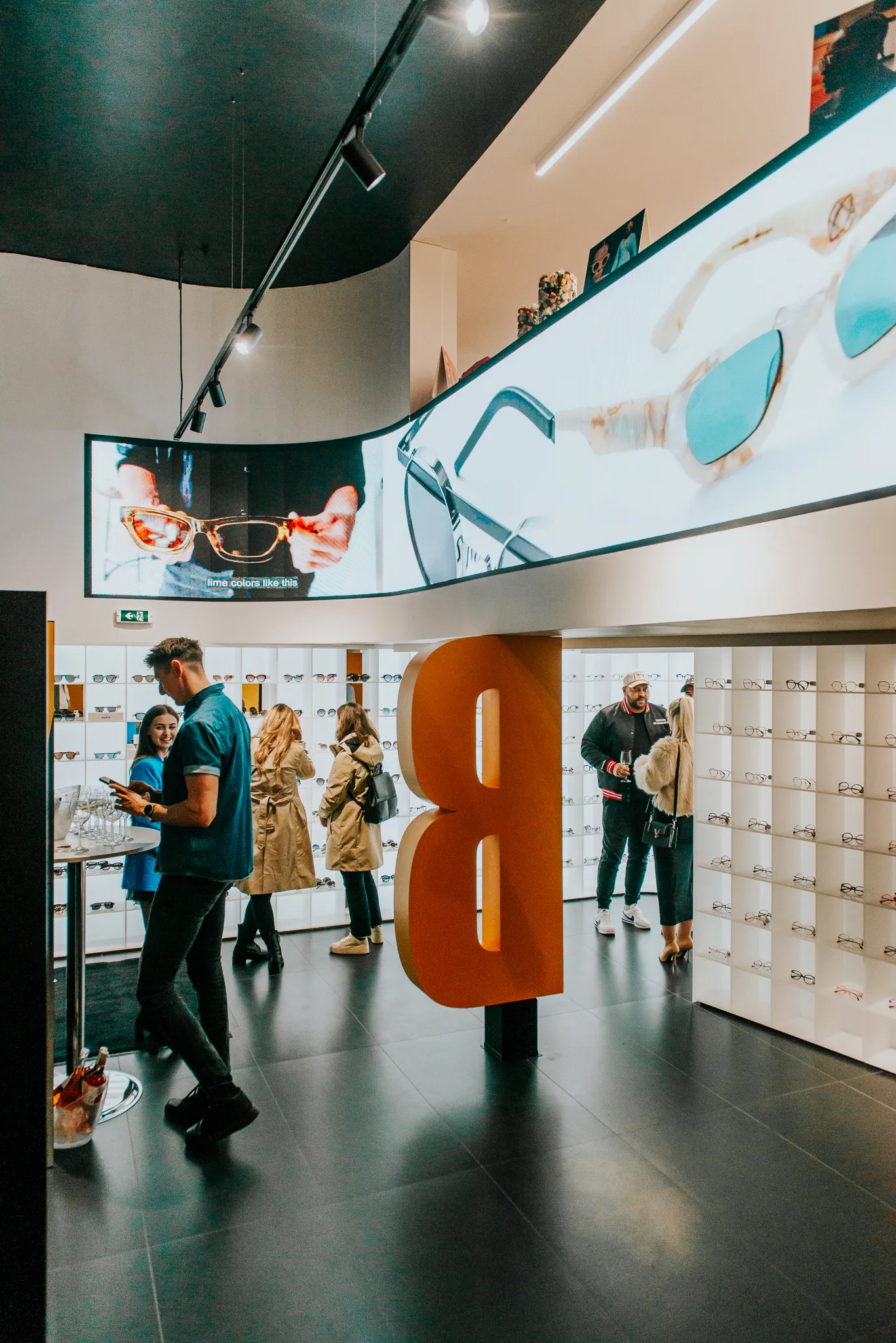
Curved Retail LED Display at Blink Optic in Bucharest
Uniview LED's GX Series indoor fixed LED display
follows the curved upper architecture inside Blink
Optic in Bucharest, Romania. Instead of adding a
conventional rectangular screen to the store, the
LED surface becomes part of the retail interior,
creating a continuous digital canvas above the
product area.
Architecture-Led Installation
GX Series · Curved Fixed LED Display
Product
GX Series
Application
Retail Display
Location
Bucharest, Romania
Installation
Curved Fixed LED
A Retail LED Display Designed Around the Architecture
The most distinctive part of this installation is
not simply the presence of an LED screen. It is the
way the display follows the existing architecture.
The curved indoor LED display
extends along the upper structure of the store and
creates a continuous digital surface above the
retail area.
This approach allows promotional video, campaign
graphics and brand content to appear as part of the
interior design rather than as a separate digital
object mounted onto a wall.
Because the screen runs through the upper part of
the store, content can remain visible from multiple
positions as customers move through the space.
Selected visuals are also visible through the large
street-facing glazing, extending the digital impact
beyond the interior.
The installation demonstrates three useful principles
for architectural retail LED: follow the physical space,
maintain visibility along the customer journey and use
the display to strengthen both the interior and the
storefront.
CURVED ARCHITECTURAL LED LINE
The display follows the upper geometry of the
retail interior instead of interrupting it
with a conventional rectangular screen.
01
Shaped to Follow the Interior
The GX Series extends around the curved upper
structure of the store. This allows the display
geometry to respond to the architecture rather
than forcing the architecture to accommodate a
conventional flat video wall.
Design Logic
Architecture first
02
Visible Along the Customer Journey
Positioning the LED display above the product
fixtures helps digital content remain visible
from different areas of the store as customers
move between displays and circulation zones.
Retail Role
In-store visibility
03
Extending Digital Content Toward the Storefront
Parts of the moving content can also be seen
through the large exterior windows. This gives
the indoor display a secondary storefront role,
especially when dynamic content is visible from
the surrounding street.
External Effect
Storefront presence
RETAIL VIEWING PATH
01
Closest customers beneath the display
02
Customers moving across the sales floor
03
Sightlines from other areas of the store
04
Partial visibility through storefront glazing
RETAIL SPECIFICATION
Pixel Pitch Should Follow the Real Viewing Distance
Retail LED selection should begin with the closest
important customer viewing position, screen dimensions
and content detail. A smaller pixel pitch increases
pixel density, but it should be selected because the
viewing condition requires it—not simply because a
smaller number appears better on a specification sheet.
For curved architectural installations, cabinet
dimensions, module orientation, screen geometry and
service access also need to be considered before
finalizing the LED wall layout.
The project images show the LED surface from several
viewpoints: its curved relationship with the ceiling
structure, its position above the product area and its
visibility toward the storefront.
Curved GX Series LED display integrated above the
retail product area.
Wide view showing how the LED display follows
the architectural curve.
LED content positioned above the in-store
customer circulation zone.
Dynamic indoor LED content contributes to
storefront visibility.
CURRENT PRODUCT REFERENCE
Current GX Indoor Fixed LED Display Platform
The current GX platform provides a useful reference
for buyers evaluating similar retail and
architecturally integrated indoor LED walls.
These are current GX product specifications for
purchasing reference. They should not be interpreted
as verified project-specific measurements from the
Blink Optic installation.
Current Pixel Pitch Options
GX 1.95 · 1.953 mm / GX 2.6 · 2.604 mm
Brightness
600 cd/m²
Refresh Rate
7,680 Hz
Cabinet Depth
47 mm
Cabinet Architecture
Multiple cabinet formats for non-standard
indoor LED wall layouts
Maintenance
Front-service design
01
Closest Viewing Distance
Measure the closest normal customer position
and typical circulation distance before
choosing pixel pitch.
02
Architectural Geometry
Record straight walls, curves, corners,
columns, ceiling transitions and other
geometry that affects the LED cabinet map.
03
Active Screen Dimensions
Define the required active width and height
before calculating cabinet quantities,
native resolution and content format.
04
Ambient Light and Glazing
Evaluate indoor lighting, reflections,
nearby windows and direct daylight before
defining the operating brightness.
05
Maintenance Access
Confirm whether technicians can access the
rear of the display. Wall-mounted retail
installations often benefit from a
front-service architecture.
06
Content Strategy
Define whether the screen will carry campaign
video, product messaging, brand storytelling
or decorative visual content before
determining final resolution and aspect ratio.
Continue Exploring Retail LED Display Solutions
Move from this real-world project into product
specifications, retail applications and technical
buying guidance.
Key project facts plus practical questions for
retailers, designers and integrators planning
similar indoor LED installations.
What LED display was installed at Blink Optic?
The project information identifies the
installed product as Uniview LED GX Series
indoor fixed LED display.
Where is the Blink Optic LED project located?
The project is located inside Blink Optic
in Bucharest, Romania.
What type of LED installation is used?
The project uses a curved fixed-installation
LED display that follows the upper
architecture of the retail interior.
Why use a curved LED display in a retail store?
A curved LED display can follow architectural
lines more naturally than a conventional
rectangular wall. In this project, the
display becomes part of the store geometry
while remaining visible from multiple
customer positions.
What pixel pitch should a retail LED wall use?
Pixel pitch should be selected from the
closest regular viewing distance, content
detail and total display dimensions.
Retail installations with closer viewers
generally require greater pixel density than
displays intended mainly for longer-distance
viewing.
Is front maintenance useful for retail LED displays?
Front service can be valuable when an LED wall
is installed directly against an architectural
surface and there is no practical rear service
corridor. The final service method should still
be confirmed from the actual site design.
Can an indoor retail LED display also support storefront visibility?
Yes, when sightlines and glazing allow it.
In the Blink Optic installation, selected
dynamic content remains visible through the
street-facing glass, giving the indoor screen
additional storefront presence.
Planning a Retail or Architectural LED Display?
Send Uniview LED your available wall dimensions,
architectural drawings, closest viewing distance,
ambient lighting conditions, required screen shape,
service-access conditions and project location.
Our team can help evaluate an appropriate indoor
LED display configuration.