Large Display
Physical pixels can be much larger because the audience normally views the image from meters away.

Researchers from Fuzhou University reported full-color ultrahigh-resolution quantum dot light-emitting diode pixel arrays spanning 9,072 to 25,400 pixels per inch. Published in Nature in 2026, the work addresses one of the central challenges of future near-eye displays: creating extremely small RGB pixels without sacrificing device performance and stability.
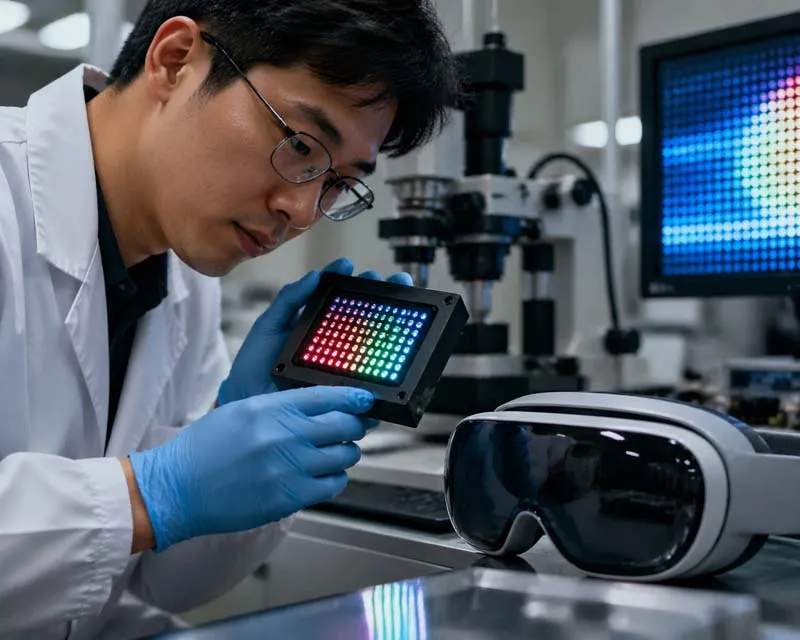
Fuzhou University researchers developed a nanoscale transfer-printing process for patterned red, green and blue quantum-dot light-emitting layers.
The reported RGB pixel arrays ranged from 9,072 to 25,400 PPI and maintained a conservative transfer yield above 99.9%. The process was demonstrated with both CdSe/ZnS and perovskite quantum dots and on rigid and flexible substrates.
The researchers also investigated a different problem that becomes increasingly serious as QLED pixels shrink: non-uniform internal electric fields around the pixel edges. Their device architecture was adjusted to improve field uniformity, efficiency and operational stability.
These values come from the published research. They are more useful than broad claims such as “better than OLED” or “ready for mass production.”
Pixel density becomes increasingly important as the viewing distance becomes shorter and the physical display area becomes smaller. Near-eye optics create a very different design problem from a television, smartphone or large-format LED wall.
Physical pixels can be much larger because the audience normally views the image from meters away.
Shorter viewing distance requires substantially greater pixel density than a large-format screen.
Optical magnification can make individual pixels and gaps far more visible to the user.
The reported QLED work demonstrates submicrometre-scale RGB patterning for ultrahigh-density display research.
The important innovation is not a conventional increase in panel resolution. It is a nanoscale patterning and transfer process designed to preserve RGB pixel quality as the structures become extremely small.
A hard silicon template is used as a nanoimprinting stamp to define the microscopic pattern structure.
Quantum-dot material is arranged within precisely defined nanoscale pixel structures.
The complete patterned layer is transferred to the target device substrate rather than positioning individual microscopic emitters.
The patterned QLED structure is combined with the electrical layers required to create an operating display device.

Ultra-high pixel density is not only a patterning problem. When QLED pixel structures become extremely small, edge geometry can distort the internal electric field.
The Nature study identified this field non-uniformity as an important efficiency and stability bottleneck in ultrahigh-resolution devices.
The researchers used TiO₂ nanoparticle incorporation to better match dielectric behavior, producing a more uniform electric-field distribution and suppressing edge-related leakage.
A useful microdisplay technology has to preserve device performance while pixel structures become smaller.
Full-color RGB QD arrays were demonstrated across densities from 9,072 to 25,400 PPI.
The researchers reported a conservative transfer yield above 99.9% for the nanoscale patterned structures.
Red QLED devices operating at 12,700 PPI reached a reported peak external quantum efficiency of 26.1%.
The red devices reported a T95 operational lifetime of 65,190 hours when tested at 1,000 cd/m².
RGB-pixelated white QLED devices reached a reported peak EQE of 10.1%.
The researchers integrated the ultrahigh-resolution QLED technology with CMOS integrated circuits and demonstrated an active-matrix animated display.
A Nature publication establishes an important research milestone. It does not automatically mean that a consumer AR headset using the same technology is ready for mass production.
Ultrahigh-resolution RGB QD pixel arrays.
Red, green and blue QD patterning was demonstrated.
Reported for the transfer-printing process.
Active-matrix animated operation was demonstrated.
A research demonstration does not establish mature high-volume manufacturing economics.
Final products still depend on optics, electronics, packaging and complete-system design.
OLED, MicroLED and QLED follow different material and manufacturing paths with different trade-offs.
A demonstrated research density should not be described as an established commercial standard.
In a near-eye display, the optical system magnifies a relatively small display surface. Any visible pixel structure can therefore become much more noticeable than it would on a conventional screen.
Higher pixel density can reduce visible pixel structure and provide more image information inside the small active area available to an AR or VR optical engine.
However, pixel density is only one requirement. Brightness, efficiency, color performance, lifetime, optical architecture, thermal behavior and drive electronics still determine whether a technology works in an actual headset.

The research is most relevant to applications where large amounts of visual information must fit inside a very small display area.
Compact near-eye optical systems need high information density inside a very small display engine.
Higher pixel density can help reduce visible pixel structure under optical magnification.
Compact visualization systems may benefit where high information density is required within limited physical space.
The manufacturing method provides another route for studying submicrometre RGB pixel structures and device physics.
Extremely high PPI solves only one part of the near-eye display problem.
Research-scale transfer success still has to translate into repeatable high-volume manufacturing.
Millions of microscopic red, green and blue elements must remain consistent across the device.
Extremely dense pixels require equally capable active-matrix control and electrical integration.
Very high device density concentrates electrical and thermal behavior into a small physical area.
AR performance also depends on lenses, waveguides, optical efficiency and complete light-engine architecture.
A viable consumer product requires acceptable yield, equipment throughput and total system cost.

The 25,400 PPI result is visually impressive, but the broader technical importance lies in combining nanoscale RGB patterning with useful device performance.
Future near-eye displays need more than tiny pixels. They need tiny pixels that can still be manufactured, driven electrically and operated with acceptable efficiency and stability.
The Nature research does not settle the competition between QLED, OLED and MicroLED. It adds another credible manufacturing route to the wider microdisplay technology landscape.
Key numerical claims on this page should be interpreted as published research results rather than commercial product specifications.
“Nanoscale transfer-printed full-colour ultrahigh-resolution quantum dot LEDs.” Nature 652, 349–358. DOI: 10.1038/s41586-026-10333-w
Official university release describing the ultrahigh-resolution full-color quantum-dot LED research led by Professor Fushan Li.
Move from microdisplay research into practical direct-view LED technology and specification.
Key questions about the Nature research, PPI and near-eye display technology.
The Nature paper reports full-color quantum-dot pixel arrays across a range from 9,072 to 25,400 pixels per inch.
No. The work is an advanced research demonstration. Commercial AR products still require complete optical, electrical, packaging and manufacturing systems.
QLED refers to quantum-dot light-emitting diode devices in which quantum-dot materials form the light-emitting pixel structure.
Near-eye optical systems magnify a small display area. Greater pixel density helps reduce visible pixel structure while placing more image information within that small area.
No. Pixel density alone cannot determine the best display technology. Efficiency, brightness, lifetime, optics, manufacturing yield, drive electronics and cost also matter.
Large-format direct-view LED systems are normally specified by pixel pitch in millimeters together with screen dimensions and native resolution. PPI is more common when discussing compact displays and microdisplays.
Explore the Uniview LED Knowledge Center for practical guides covering pixel pitch, viewing distance, refresh rate, COB, MIP, fine-pitch LED and professional display applications.