
Quantum Dot Color Conversion for Full-Color Micro-LED Displays
Quantum-dot color conversion is one of the leading approaches for producing full-color Micro-LED displays from a blue Micro-LED source.
Instead of transferring separate red, green and blue LED chips for every pixel, patterned quantum-dot color-conversion layers convert selected blue light into red and green emission. A 2025 research prototype demonstrated a 600 ppi full-color Micro-LED display with a 115% NTSC color gamut.
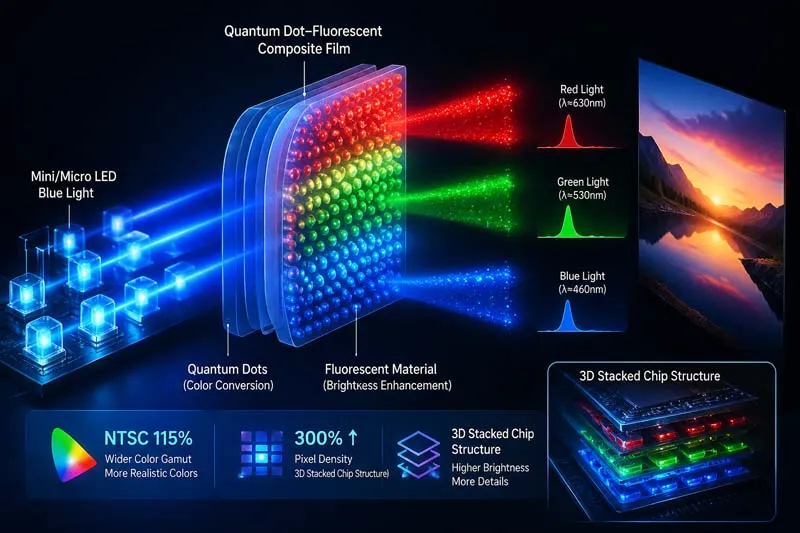
What Is Quantum Dot Color Conversion in a Micro-LED Display?
Quantum-dot color conversion uses a blue Micro-LED array as the light source and places patterned red and green quantum-dot conversion layers over selected subpixels. Blue light remains blue where no conversion is required, while quantum dots convert blue photons into narrow-band red or green emission.
The approach can simplify full-color integration because one blue-emitter platform can generate all three display colors. However, commercial performance still depends on quantum-dot stability, patterning accuracy, optical crosstalk, conversion efficiency, Micro-LED yield, backplane integration and repair.
Why Full-Color Micro-LED Is Difficult
MicroLED refers to microscopic inorganic LED emitters. A common engineering definition places MicroLED dies below approximately 50 μm, although some commercial definitions use a broader sub-100 μm range.
Shrinking the emitter does not automatically produce a complete high-resolution display. Manufacturers must still integrate millions of emitters with a backplane, test them, align them, bond them, repair defective devices and calibrate the finished panel.
Full color creates an additional challenge. A conventional RGB architecture requires red, green and blue emitters to be integrated at extremely small spacing. Quantum-dot color conversion offers another route: start with one blue Micro-LED platform and convert part of its output into red and green.
How Quantum-Dot Color Conversion Works
Blue Micro-LED Source
A blue GaN Micro-LED array provides the primary emitted light.
Red QD Layer
Patterned red quantum dots absorb blue photons and re-emit them at a longer red wavelength.
Green QD Layer
A separate green quantum-dot pattern performs the same conversion process for green subpixels.
Full-Color Output
Converted red and green light combines with unconverted blue emission to form the RGB image.

Why Quantum Dots Are Attractive for Full-Color Micro-LED
Narrow Emission
Quantum dots can produce relatively narrow spectral peaks, helping separate red, green and blue primaries for wider color-gamut performance.
Tunable Wavelength
Emission wavelength can be engineered through quantum-dot material composition and particle size.
One Blue Emitter Platform
Color conversion can reduce dependence on integrating three different LED emitter materials at every RGB pixel.
What the 115% NTSC Result Actually Demonstrated
A 2025 ACS Photonics study developed high-resolution red and green quantum-dot color-conversion layers using a microfluidic patterning process.
The researchers reported color-conversion structures with approximately 1285 ppi resolution and 5 μm × 5 μm minimum conversion features. These layers were integrated with a blue GaN Micro-LED array to build a 600 ppi full-color prototype.
The resulting prototype reached approximately 115% NTSC color gamut. The research also focused on reducing optical crosstalk between neighboring color-conversion regions, which is essential as subpixels become smaller.

Quantum-Dot Color Conversion Is Not the Same as 3D LED Stacking
Quantum-dot color conversion and vertically stacked LED structures are separate engineering approaches.
Color conversion addresses how a Micro-LED system generates red, green and blue light. Three-dimensional stacking addresses how emitters, drivers or color layers may be integrated vertically to reduce footprint or increase functional density.
They can potentially appear in the same future display architecture, but a result reported for one approach should not automatically be attributed to the other.
Important: the commonly cited 2025 115% NTSC Micro-LED result does not establish that a three-dimensional stacked chip structure increased pixel density by 300%. That figure should not be used unless a specific peer-reviewed source or released technical document supports it.
Chip Size and Pixel Pitch Are Different Specifications
| Term | What It Describes | Typical Engineering Interpretation | Do Not Confuse It With |
|---|---|---|---|
| Mini LED | LED emitter size class | Often approximately 50–200 μm | Finished display pixel pitch |
| MicroLED | Microscopic LED emitter class | Often below approximately 50 μm | Finished PPI or pixels/m² |
| Pixel Pitch | Center-to-center pixel spacing | P0.7, P0.9, P1.2, etc. | Individual LED die size |
| PPI | Pixels per inch | Used frequently for microdisplays | Quantum-dot feature size alone |
In a direct-view LED display, pixel density is determined by finished pixel pitch. A smaller LED die may enable a smaller pitch, but the relationship is not one-to-one because routing, electrodes, black area, driver architecture, optical isolation and manufacturing tolerances also occupy space.
What Still Limits Quantum-Dot Micro-LED Commercialization?
QD Patterning
Red and green conversion materials must be deposited at very small dimensions with consistent geometry and thickness.
Optical Crosstalk
Light leaking between adjacent subpixels can reduce color purity and become more difficult to control as pixel size falls.
Material Stability
Quantum dots must maintain optical performance under blue-light exposure, heat, oxygen and moisture over the required lifetime.
Micro-LED Yield
High-resolution displays require extremely high emitter yield, inspection accuracy and effective repair strategies.
Mass Transfer
Depending on the architecture, millions of microscopic emitters or arrays must still be integrated with a backplane accurately.
Calibration
Finished displays require luminance and color uniformity correction across large numbers of microscopic pixels.
Where Could Quantum-Dot Micro-LED Be Used?
AR / Near-Eye Displays
Very high pixel density is valuable where a small display is viewed through magnifying optics close to the eye.
Wearable Displays
Compact self-emissive displays can benefit from high brightness, fast response and small pixel dimensions.
Fine-Pitch Professional Displays
Related MicroLED, MIP and advanced packaging technologies may contribute to future close-view professional display systems.

What Should You Verify in a Quantum-Dot or Micro-LED Specification?
Confirm whether “MicroLED” refers to die size, packaging technology or the finished display product.
Check finished pixel pitch or PPI instead of relying only on emitter dimensions.
Ask which color-gamut standard is used: NTSC, DCI-P3, Adobe RGB or Rec.2020.
Request quantum-dot material, conversion efficiency, aging conditions and lifetime data.
Verify optical-crosstalk control between neighboring converted subpixels.
Review Micro-LED transfer, bonding, yield, defective-pixel repair and calibration methods.
Separate laboratory prototype specifications from mass-production product specifications.
Validate brightness, contrast and color uniformity under the intended operating conditions.
How This Research Relates to Commercial LED Displays
Quantum-dot Micro-LED research should not be treated as a specification for every commercial fine-pitch LED wall. Current professional LED products may use SMD, COB, MIP, Mini LED or other integration routes depending on pixel pitch, application, service requirements and manufacturing maturity.
For a real project, start with viewing distance, required resolution, brightness, camera use, maintenance access and operating environment before selecting a packaging technology.
Explore more engineering explanations in the Uniview LED Knowledge Center .